



Lead generation • A practical guide
Lead qualification: give every enquiry a clear next step
An enquiry is a starting point. Decide the next action before you write the proposal.
Lead qualification is the process of checking whether an enquiry fits your offer, whether the buyer is ready to move forward, and what your team should do next. It helps you distinguish a useful sales conversation from a request that needs clarification or later follow-up.
Key takeaways
- Separate fit from buying readiness. A suitable customer may need more time.
- Record what the person actually said. Keep assumptions and missing information visible.
- Ask enough to choose the next action, rather than making every enquiry complete a long interview.
- A lead score can help order a queue. It does not prove that someone will buy.
- Measure qualified enquiries and sales outcomes alongside the total number of leads.
What lead qualification should tell you
Suppose your business receives twenty enquiries. Some people need a service you provide. Some want something outside your scope. Others are still comparing options.
Sending the same proposal to everyone leaves an important question unanswered: what does each person need from you now?
A useful qualification process gives your team three things: a reason to continue the conversation, the information still missing, and a named next action.
That action might be a discovery call, a request for measurements, an explanation of your service scope, or a follow-up on an agreed date. A quote is only one possible outcome.
Fit and readiness are different
Fit means the requirement matches what you can deliver. For an interior company, this could include the project type, location, scope and workable budget.
Readiness means there is enough agreement and information to take the next step. The customer may fit your service but be waiting for possession of a flat, approval from a partner, or a confirmed brief.
Keep those two checks separate. Otherwise, a person who is suitable but early in the buying process can disappear into a “bad lead” category.
Qualification also starts before the enquiry arrives. Your offer and audience affect who contacts you. If most requests are outside your scope, review your audience analysis and segmentation alongside the sales process.
Ask questions that change the next action
You do not need to ask everything in the first message. Start with the information that prevents an unsuitable recommendation or an unnecessary proposal.
Use the following questions as a conversation guide. Adapt them to the service, the value of the project and what the customer has already told you.
On a phone, swipe the table sideways to see all columns.
| What to understand | A reader-friendly question | What the answer changes |
|---|---|---|
| Requirement | What would you like help with, and what is happening at present? | Whether your offer can solve the problem. |
| Scope | Which parts of the work should we include? | What needs to be estimated or investigated. |
| Location or delivery | Where is the project, or how would you prefer the work to be delivered? | Whether your team can serve the requirement. |
| Timing | When would you like to start? Is anything else needed before that? | A practical next step and follow-up date. |
| Budget | Have you set a working range, or would you like to understand the options first? | Whether to discuss scope, alternatives or a proposal. |
| Decision process | Who else will review the plan or approve the work? | Who should join the next conversation. |
| Next action | Would a short discussion help, or should we send some information first? | A useful, agreed follow-up. |
Give context before asking about budget
“What is your budget?” can be difficult to answer when the customer does not yet understand what is included.
Explain the main scope choices first. For example, an interior designer can separate a kitchen-only project from full-home interiors. Then ask which range or scope the person is considering.
If no budget exists yet, record that accurately. Do not turn uncertainty into an invented number. You can still explain what affects the estimate and ask whether the customer wants a scope discussion.
Understand approval without dismissing the first contact
The person making the enquiry may coordinate the purchase without signing it off. That does not make the conversation worthless.
A consultant speaking to an operations manager may need the finance team involved later. An interior designer may need both homeowners to approve a plan. Ask how the decision will happen, rather than treating “not the final approver” as an automatic rejection.
How an interior design enquiry moves forward
Consider Aangan Rooms, a fictional interior design studio serving Kolkata. A customer asks about interiors for a three-bedroom flat, with possession expected in December.
The project and location appear to fit. But the scope and budget are not confirmed, and the couple plans to review the options together.
The sensible next action is to clarify scope and discuss the working budget. Sending a detailed final quotation now would require assumptions.
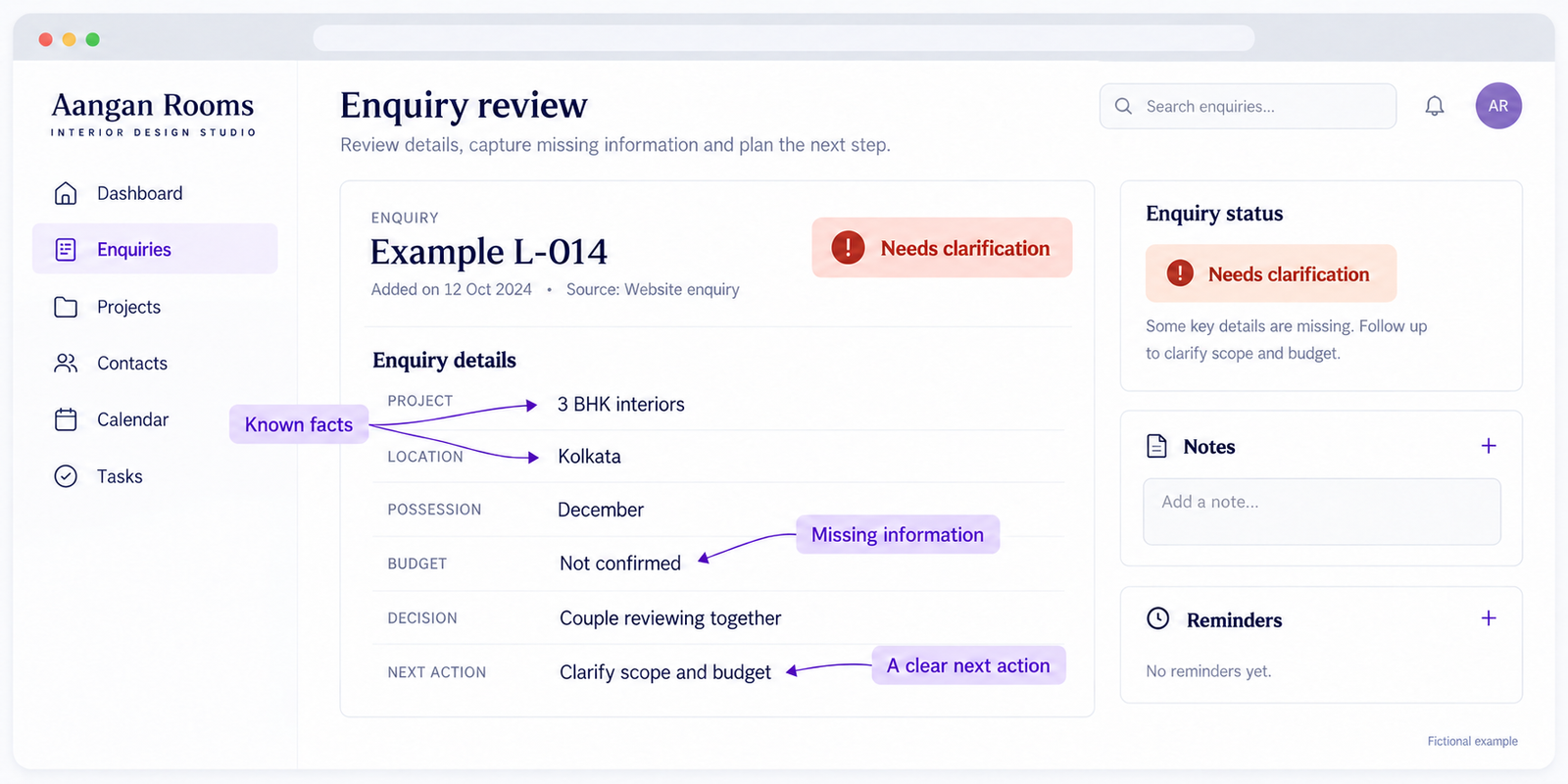
A reply could read:
“Thanks for sharing the details. We can discuss a 3 BHK interior project in Kolkata. Are you considering the full flat or selected rooms? If you have a working budget range, please share it. If you are still deciding, we can explain the scope options in a short call with both of you.”
Notice what this message does. It confirms the relevant details, asks about the missing information and offers a useful next step. It does not assume that the customer is ready to approve a quote.
The same principle applies to existing lead generation activity. Our guide to generating leads for an interior design business covers attracting enquiries. Qualification helps you handle those enquiries after they arrive.
Three possible routes from the same enquiry
- A discussion now: The customer confirms the scope, shares a workable range and wants to review options.
- Clarification first: Key details are still missing, so your team asks focused questions.
- Follow-up later: The project fits, but the customer agrees to revisit it after possession or another milestone.
If the work is outside your service area or scope, explain that clearly. Where appropriate, suggest a more suitable type of provider. Do not keep a confirmed mismatch in the active sales queue just to make the lead total look better.
Use BANT and lead scoring as tools
BANT stands for Budget, Authority, Need and Timeline. HubSpot’s qualification guide explains this framework and other approaches. These four areas can help organise a sales conversation.
For everyday service enquiries, use them flexibly. Start with the customer’s requirement, then discuss scope, budget, decision process and timing as the conversation develops.
A complex manufacturing or consulting purchase may need more detail: how the supplier will be selected, what success should look like, and which teams must approve the work. A straightforward service enquiry may not need that depth.
Lead qualification versus lead scoring
Qualification checks the evidence and decides what should happen next. Scoring assigns points to selected attributes or actions to help prioritise records.
A person can open several emails and still have an unsuitable requirement. Another person may browse very little but submit a clear brief and request a meeting.
HubSpot’s lead scoring documentation distinguishes fit based on record properties from engagement based on events. Your team should also keep those ideas separate when deciding which signals matter.
You can begin with simple statuses rather than a numerical score. If you later add scoring, write down each rule, check the underlying evidence and review exceptions. The weights are business choices that need validation; a score is not a buying probability.
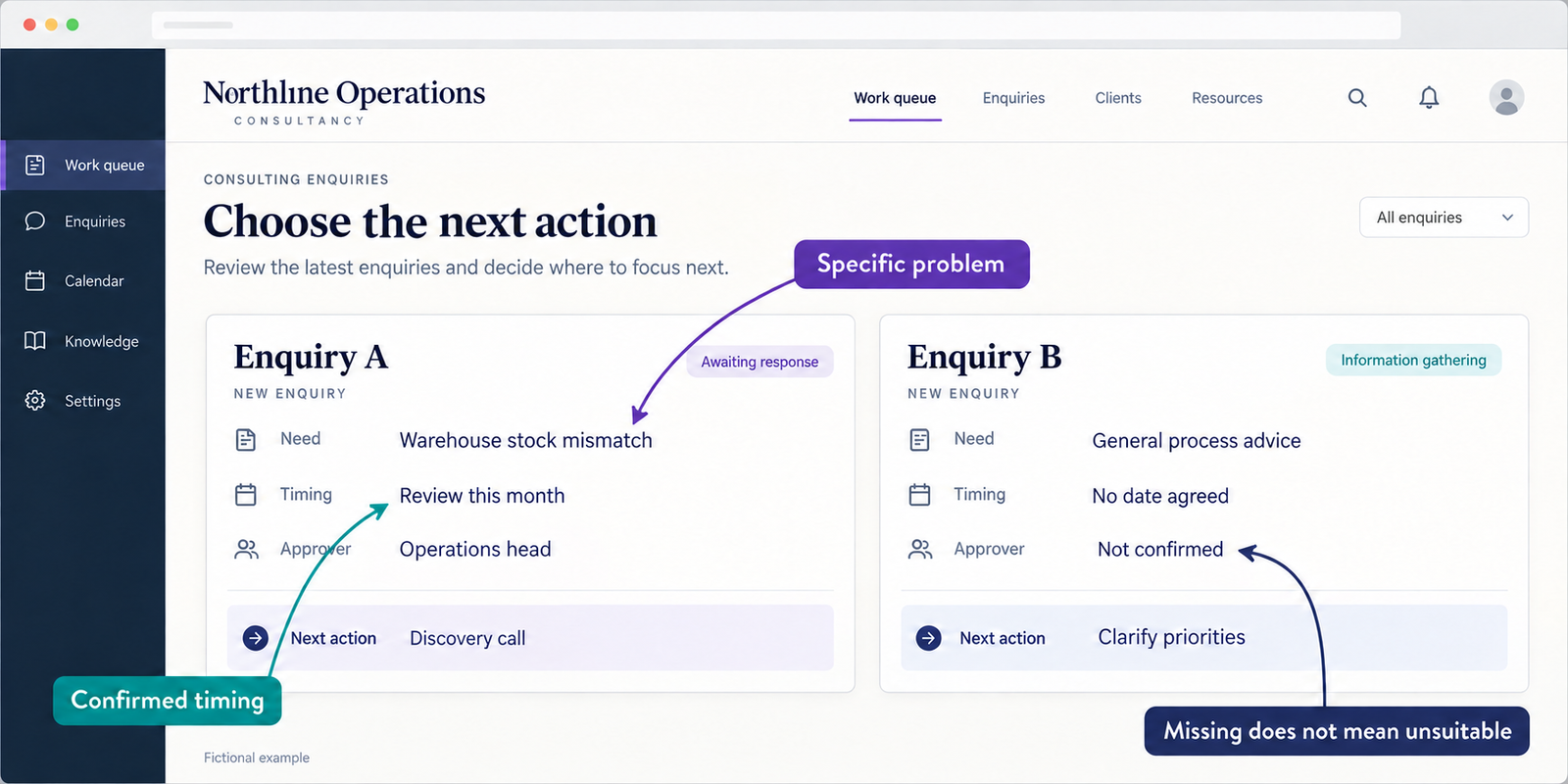
In this consulting example, Enquiry A describes a warehouse stock mismatch and a review this month. A discovery call is reasonable. Enquiry B asks for general advice but gives no date or approval details. It needs clarification.
Neither route requires a guess about the customer’s income or the size of the business. The evidence relates to the problem and the next conversation.
A lead qualification worksheet you can copy
This is an original editorial template for this guide. It is a starting point, not a tested client system or a universal qualification standard.
Enquiry reference:
Date and source:
Requested service or product:
Customer’s stated problem:
Scope and location:
Timing and dependencies:
Budget status: Confirmed / exploring options / not discussed
Decision process:
Evidence supporting fit:
Missing information:
Current status: Sales discussion / clarification / follow-up later / unsuitable / no response
Reason for status:
Next action, owner and due date:
Keep evidence close to the status. “Customer said possession is expected in December” is more useful than “probably interested.” If you infer something, label it as an assumption and check it.
For later follow-up, agree a date or milestone where possible. For an unsuitable enquiry, record the business reason: unsupported location, unavailable service or incompatible scope.
Do not collect unnecessary personal documents or private details just to qualify a routine enquiry. Restrict access to customer records and use approved systems for storing them.
Make follow-up clear before adding automation
A qualification process needs someone to act on it. A status without an owner can leave a useful enquiry waiting.
Set a response target your team can actually meet. Explain your business hours and handle requests received outside those hours consistently. There is no single response deadline in this guide that applies to every industry.
For a clarification request, state what you need and why. For a sales call, tell the person what the discussion will cover. For later follow-up, record the agreed date and avoid repeated messages without a useful reason.
Where AI can help
AI can assist with summarising an enquiry, identifying unanswered fields and drafting a reply for review. It should preserve uncertainty: “budget not provided” is accurate; an invented estimate is not.
As an editorial recommendation, start with a narrow task and test it on fictional records before using customer data. Have a person review the summary and next action, especially when the request is ambiguous.
A simple rule can route an enquiry to clarification when a required field is missing. A summary model can help interpret longer text. Keep the original message available so your team can verify the output.
Automation also needs a failure route. If a record is not created or a task is not assigned, somebody must be able to see the problem and respond manually.
Before investing in automation, check whether your enquiry form captures useful information and sets expectations. The guide to a website that converts ad clicks into leads covers the connection between the page, offer and enquiry.
Measure qualified leads without hiding the denominator
Lead totals tell you how many enquiries arrived. They do not tell you how many matched your offer or progressed to a useful sales conversation.
Choose a consistent definition of a qualified lead before comparing campaigns. For example, your team might require confirmed service fit and an agreed discovery call. Write that definition down and keep it stable during the comparison.
A transparent cost example
Suppose a fictional campaign spends ₹24,000, receives 80 unique enquiries and produces 20 qualified enquiries under the team’s agreed definition.
Cost per enquiry: ₹24,000 ÷ 80 = ₹300
Qualified enquiry rate: 20 ÷ 80 × 100 = 25%
Cost per qualified enquiry: ₹24,000 ÷ 20 = ₹1,200
These figures are illustrative arithmetic, not Webinnovators client results, a recommended spend or an industry benchmark.
The ₹300 figure and the ₹1,200 figure answer different questions. Report both, then track the agreed next step, proposals and won business. A campaign with more qualified enquiries is not automatically more profitable.
Use one consistent treatment of duplicates and spam. Keep unsuitable enquiries visible with reasons. Report pending and unanswered records separately, because an unreviewed enquiry is not yet proven to be unsuitable.
Compare records received in the same period and allow comparable time for follow-up. Changing the qualification rule halfway through can make an apparent improvement misleading.
Google Analytics lets you mark important events as key events. That setting expresses what matters to your business; it does not independently verify the quality of a lead. Connect reporting with your reviewed customer records, using an appropriate measurement setup.
Review disagreements as well as totals
If two team members would give the same enquiry different statuses, examine the rule. Perhaps “ready” needs a clearer definition, or the budget question lacks context.
Review a manageable sample of accepted, unsuitable and pending records. Look for missing evidence, forgotten tasks and assumptions. Use what you learn to improve the worksheet, rather than changing rules simply to increase the reported qualification rate.
Common questions about lead qualification
Does every business need a CRM?
You need a reliable record and follow-up process. A shared sheet may be enough for a simple workflow. A CRM becomes useful when multiple people, stages or channels make ownership and history harder to manage. Choose around the process you need, not the number of features.
Should a lead without a budget be rejected?
Not automatically. Clarify the scope and explain relevant options first. If the customer confirms a budget that cannot support the required work, discuss a smaller workable scope or explain the mismatch honestly.
How many qualification questions should a form ask?
Ask for the minimum information needed to route the enquiry responsibly. The right amount depends on the purchase. Test whether people understand the questions, and move details that need a conversation into the follow-up.
What if the person does not reply?
Record “no response” separately from “unsuitable.” Follow your agreed contact process and stop when further messages would be unhelpful or the person asks you to stop. Do not invent the reason for silence.
Give every enquiry a reasoned next step
Begin with the offer, the evidence and the next action. Keep missing information visible, give each follow-up an owner, and compare outcomes using a consistent definition.
If your business receives enquiries but struggles to connect campaigns with useful sales conversations, explore Webinnovators’ digital marketing services. A useful starting brief is your current enquiry journey, the information you collect and where follow-up gets stuck.
