



Website development • A buyer’s guide
Ecommerce website cost in India: compare quotes and plan your budget
The price of a store is easier to understand when you know what has to happen after a customer clicks Buy.
Ecommerce website cost includes the initial build, recurring platform or hosting costs, paid tools, support and costs that change with orders. To plan a useful budget in India, define the catalogue and order workflow first, then compare written quotes for the same scope.
There is no single development price that applies to every store. This guide shows what to ask for, how to compare the options and how to calculate a first-year budget without treating a sample number as a market rate.
Key takeaways
- Compare the same deliverables before comparing the total price.
- A platform subscription and a developer’s setup fee pay for different things.
- Catalogue variations, integrations and order rules can change the work considerably.
- Separate launch costs, recurring costs and charges linked to sales.
- Ask who owns the accounts, who maintains the store and what happens when an integration fails.
What are you actually paying for?
Two stores can look similar on a phone and require different amounts of work behind the scenes.
One sells ready-stock products at a single price. Another gives approved dealers different prices, checks warehouse stock and accepts orders only in supported delivery areas.
The difference is not just the homepage design. It is the information, rules and connections needed to complete an order correctly.
Start by separating the budget into three parts.
Work needed to launch
This can include requirements planning, theme setup or custom design, catalogue preparation, checkout configuration, payment and shipping connections, content entry, testing and staff training.
Ask whether the quote includes product photography, descriptions and uploading the complete catalogue. “Product page included” may refer to a page template rather than entering every product.
Costs needed to keep the store running
These may include a platform plan or hosting, domain renewal, paid apps or extensions, maintenance and support. Some renew monthly; others renew annually.
Record the renewal amount, billing frequency and account owner. A discounted first year does not establish the cost of the second year.
Costs that change with orders
Payment processing, shipping, cash-on-delivery handling and returns can vary with transaction volume or order characteristics. They need their own assumptions.
Keep advertising, stock purchases, packaging and warehouse expenses visible in the wider business budget. A website development quote usually cannot tell you the complete cost of operating a retail business.
Shopify, WooCommerce or a custom build?
Choose around the selling workflow and the support your business can provide. A more expensive build is useful only when it solves a requirement you actually have.
On a phone, swipe the table sideways to see all columns.
| Approach | What to budget for | What to confirm before choosing |
|---|---|---|
| Hosted platform, such as Shopify | Plan, setup or design work, apps, payment-related charges and support. | Plan features, country availability, app renewals and any third-party payment fees. |
| WooCommerce on WordPress | Hosting, setup or development, optional extensions, payment processing and ongoing upkeep. | Who manages hosting, updates, backups and compatibility checks. |
| Custom application | Discovery, design, development, infrastructure, integrations, testing and continuing engineering support. | The requirement that needs custom work, documentation, ownership and the maintenance plan. |
Shopify: distinguish the plan from the implementation
Shopify’s official India pricing page lists plans and included features, including hosting. It also explains that third-party transaction fees may apply and that payment options can vary by country.
The platform’s plan charge does not include every service you might commission from a developer. Catalogue setup, brand-specific design, integrations and migration can form a separate implementation quote.
Check the actual billing interval and renewal terms. List every paid app alongside the platform plan so the subscription total is clear.
WooCommerce: free core software still needs a running budget
WooCommerce’s pricing information describes the core platform as free and open source, with no monthly core subscription. Hosting, added features and payment processing remain separate decisions.
Free software does not remove the work of configuring a store or keeping it reliable. Ask who updates the site, tests important functions, maintains backups and restores it if something goes wrong.
Compare the complete support arrangement rather than assuming one platform will always be cheaper.
Custom development: name the business rule first
A manufacturer might need approval-based dealer access, negotiated price lists or an unusual product configuration. Those requirements deserve careful discovery.
They do not automatically mean the entire store must be built from scratch. Ask whether an existing platform, extension or integration can support them reliably.
If custom development is justified, the quote should explain the specific work, its boundaries and how it will be maintained. “Unlimited features” is not a usable scope.
Why the catalogue can change ecommerce website cost
Imagine Loom & Leaf, a fictional Kolkata home-textile retailer. It sells cushion covers in different colours and sizes.
“Upload 60 products” sounds straightforward. But the team first needs to know which combinations are sold, whether each has its own stock quantity, and which images belong to which option.
A stock keeping unit, or SKU, is an identifier used to track an item. A variation is an option combination, such as a teal cushion cover in the 40 cm size.
WooCommerce’s variable product documentation explains that individual variations can have their own prices, stock and images. That is why a product count alone does not describe all the catalogue work.
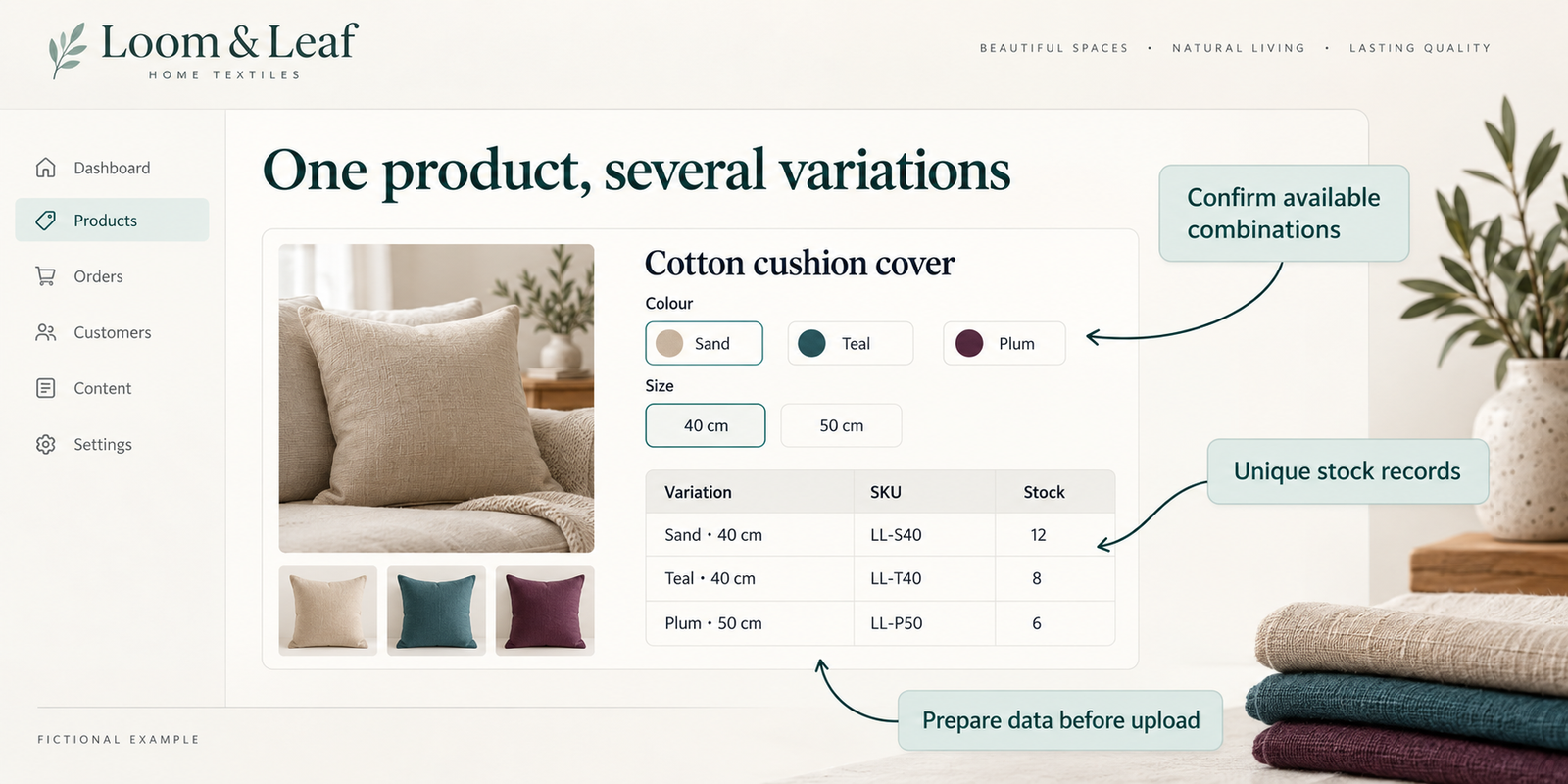
If the retailer supplies a clean catalogue with agreed variations and usable photographs, the implementation brief is clearer. If the developer must reconcile inconsistent names, missing images and stock records, include that work in the quote.
The same issue appears in migration. Copying product titles is different from preserving variations, customer records and order history.
Define exactly what must move and how the team will check it. Do not assume “migration included” covers every record.
Understand the customer before adding features
A retail shopper and a wholesale buyer may need different information and approval steps. A public checkout may suit one; the other may need a quote request or an approved account.
Use audience analysis and segmentation to clarify who the store serves. This gives feature decisions a business reason rather than turning the brief into a collection of attractive add-ons.
Calculate a first-year budget you can explain
The following is a fictional worked example. The inputs are chosen to demonstrate arithmetic, not to state Webinnovators prices or typical Indian development rates.
Assume Loom & Leaf sets aside ₹80,000 for launch work. It also assumes ₹3,000 a month for fixed recurring costs, ₹1,00,000 a month in payments processed, a hypothetical processing rate of 2%, and a ₹12,000 planning reserve.
The assumed 2% is a calculation input, not a statement of a provider’s current contract rate.
| Budget line | Calculation | Annual amount |
|---|---|---|
| One-time launch work | Chosen sample input | ₹80,000 |
| Fixed recurring costs | ₹3,000 × 12 | ₹36,000 |
| Assumed processing fees | ₹1,00,000 × 12 × 2% | ₹24,000 |
| Planning reserve | Chosen sample input | ₹12,000 |
| Illustrative subtotal | ₹80,000 + ₹36,000 + ₹24,000 + ₹12,000 | ₹1,52,000 |
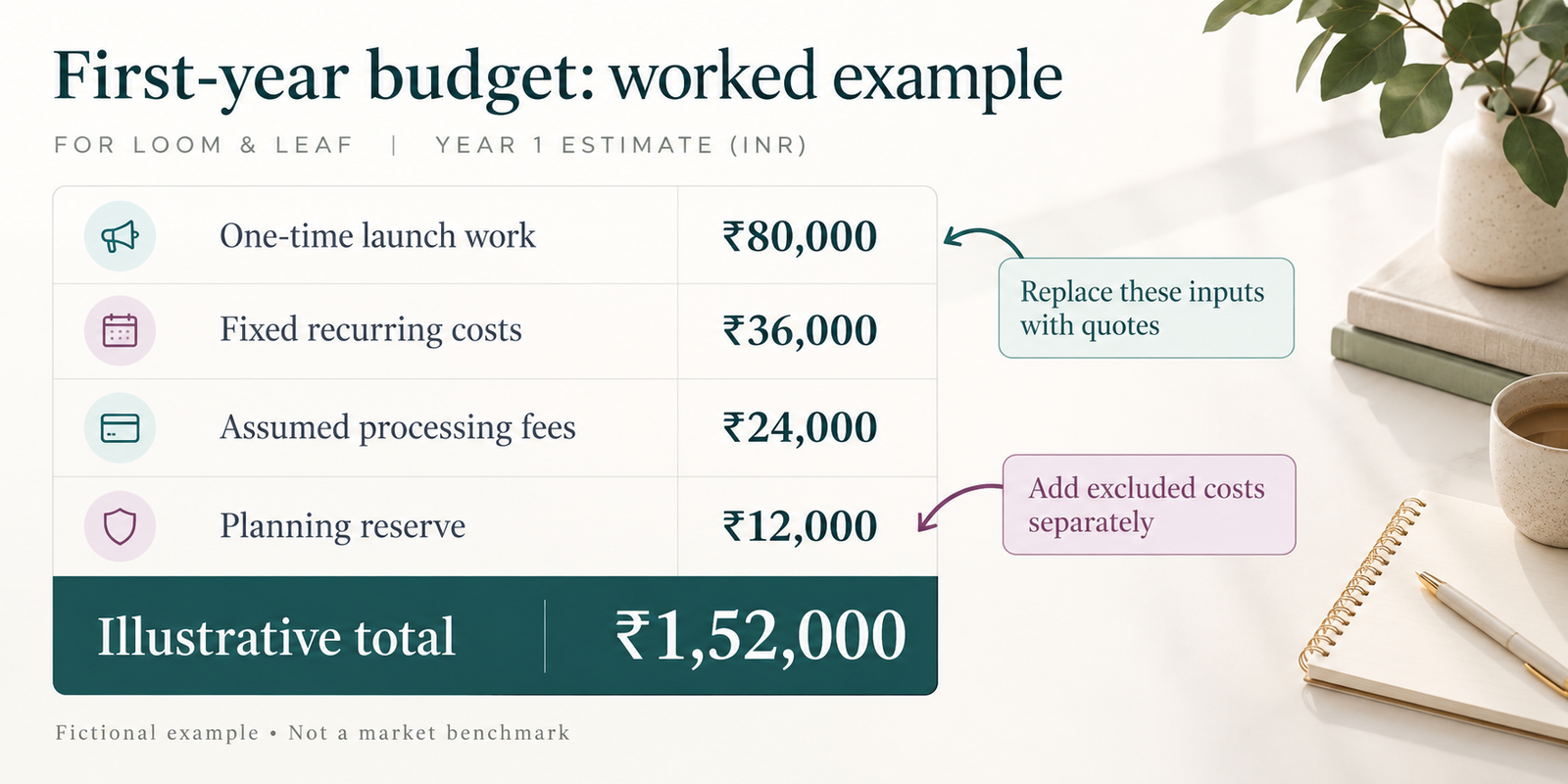
This subtotal excludes taxes, any additional platform transaction fee, shipping, returns, packaging, stock and advertising. Add each applicable cost separately. If a quotation already includes a charge, avoid counting it twice.
For example, if monthly processed payments in the scenario become ₹2,00,000, the assumed processing line becomes ₹48,000 a year. The launch fee does not change simply because the payment volume changes.
Real payment pricing depends on the provider, payment method and applicable terms. Review the chosen provider’s current schedule, such as Razorpay’s pricing information, before replacing the sample rate.
Check the second year too
Some launch work will not repeat. Subscriptions, renewals and support may continue, and a redesign or integration change may introduce new project work.
List one-time and continuing items separately. Ask what happens at renewal and whether support hours, response arrangements or licence terms change.
A low first-year offer can still be a sensible choice. You need enough detail to understand what follows it.
Compare two quotes on the same sheet
Put the proposals next to each other and replace broad labels with specific deliverables. A blank answer is something to clarify, not permission to assume inclusion.
| Item to compare | Ask both providers | Record |
|---|---|---|
| Design | Theme configuration or custom layouts? Which screens and revision rounds? | Included / excluded / needs clarification |
| Catalogue | How many products and variations? Who supplies and enters data? | Quantity, responsibility and format |
| Payments and shipping | Which providers, delivery rules and tests are included? | Connection scope and ongoing fees |
| Integrations | What data moves, in which direction, and what happens on failure? | Systems, rules and monitoring owner |
| Running costs | Which plans, licences and support renew? | Amount, frequency and owner |
| Handover | Which accounts, files, documentation and training are provided? | Access and acceptance conditions |
Consider a warehouse connection. One proposal may include installing a connector. Another may include mapping product identifiers, testing stock updates and defining a manual process if synchronisation fails.
Those are different scopes even if both say “inventory integration.” Ask for the workflow in plain language.
Also clarify changes after approval. A quote should explain how extra work is estimated and authorised. It should distinguish correcting an agreed deliverable from adding a new requirement.
A requirements brief you can copy
This original editorial template helps you request comparable quotes. It is a starting point, not a tested client system.
Business and products:
Who will buy: Retail / wholesale / both
Launch catalogue: Products, available variations and stock records
Content ready: Images, descriptions, policies and product data
Payments: Intended provider and payment methods
Delivery: Regions, shipping rules and returns workflow
Connections: Inventory, accounting, CRM or other systems
Existing data to move:
Required screens and customer actions:
Staff who will operate the store:
Target launch date and dependencies:
Budget to discuss: Launch / recurring / order-related costs
Scope exclusions:
Acceptance tests and handover:
Separate essential launch requirements from later improvements. “Customers must select the correct size” is a requirement. “We might want a loyalty programme later” can stay in the future list until its purpose and cost are understood.
For the wider planning process, our guide to website development services explains the relationship between design, functionality and business needs.
Budget for testing and a usable handover
A store needs to complete important customer and staff tasks, not simply display attractive pages.
Agree acceptance checks before the build starts. For the textile example, a useful checklist includes selecting a variation, checking the stock rule, applying a valid coupon, completing a test payment, receiving an order notification and processing a test cancellation.
Test the relevant delivery locations and payment outcomes. Use the provider’s approved testing method rather than exposing real customer records.
On mobile, check whether buyers can read the product details, choose options and understand the final charges. The price of a design means little if the buying journey is difficult to use.
Our guide to a website that converts ad clicks into leads discusses matching page content with customer intent. An ecommerce store needs the same clarity, followed by a working purchase journey.
Confirm access and responsibility
Keep the business’s platform, domain and payment accounts under appropriate business ownership. Give service providers the access they need without sharing one unrestricted login with everyone.
Record who handles routine updates, who can restore a backup and who investigates a failed payment or stock connection. Ask what documentation and training your team receives.
If a provider relationship ends, the handover should let the business understand its store and arrange continuing support. Agree those deliverables in writing.
Common questions about ecommerce website cost
Can I start with a smaller scope?
Yes. Launch with the catalogue and buying workflow you can support reliably. Defer optional features with a clear reason. Do not cut essential payment, stock or order checks simply to reach a headline budget.
Is WooCommerce always cheaper than Shopify?
No universal cost conclusion follows from the software price. Compare hosting or plans, paid tools, implementation, support and applicable transaction charges for the same requirements.
Does a higher development quote mean a better store?
The price alone cannot establish quality. Look for a clear scope, evidence relevant to your requirements, sensible testing and an operating plan. Ask how the provider will show that each deliverable works.
Should I ask for a fixed quote immediately?
You can ask for an initial discussion, but a meaningful fixed quote needs a defined scope. Complex integrations or unclear migration data may need a discovery stage first. Confirm what that stage produces and what it costs.
Plan the store you need to operate
Begin with the catalogue, the customer journey and the order process. Compare quotes for the same work, then calculate launch and continuing costs separately.
If you are planning an online store, explore Webinnovators’ website development services. Share your catalogue, delivery workflow and systems that need to connect. That gives the discussion a practical starting point.
