

How to Calculate Facebook Ad Budget: 7 Practical Steps
Learn how to calculate Facebook ad budget requirements from customer goals, enquiry costs, and conversion rates, then check what your business can afford.
Make every assumption visible.Explore the method
To calculate a Facebook ad budget, divide your target number of customers by your enquiry-to-customer conversion rate, then multiply the required enquiries by your expected cost per enquiry. Check that the resulting cost per customer fits your margins and the amount you can afford to test. This gives you a planning estimate, not a promise of results.
One hypothetical example. The method below shows how each number is calculated.
01Choose the outcome your budget needs to buy
A request for information is not the same as a customer. Before choosing a daily budget, write down the outcome that would make the campaign useful: booked appointments, paid projects, completed purchases, or another measurable business result.
For a service business, define three stages:
- Enquiry: someone submits a form or starts a genuine conversation.
- Qualified lead: that person meets your agreed criteria, such as service area, need, and budget.
- Customer: they purchase within the sales period you are measuring.
Count a messaging-button click separately from an actual conversation. Likewise, a phone-link click does not prove a connected call. If your process records these actions as leads, your budget model can look healthier than the business actually is.
If people click but struggle to enquire, review the page first. Our guide to building a website that converts ad clicks into leads explains the next part of that journey.
02How to calculate Facebook ad budget requirements
The simplest formula uses the share of enquiries that become customers. Enter rates as decimals: 10% becomes 0.10.
Before using the formula: the conversion rate must be greater than zero and no more than 100%. If you have no recorded sales, a zero observed rate does not produce a usable budget estimate. Start with an affordable test and clearly labelled assumptions, then update the forecast as enquiries mature. A rate based on only a few enquiries can change substantially.
Media budget = required enquiries × cost per enquiry
If you track qualification and closing separately, calculate the combined rate first:
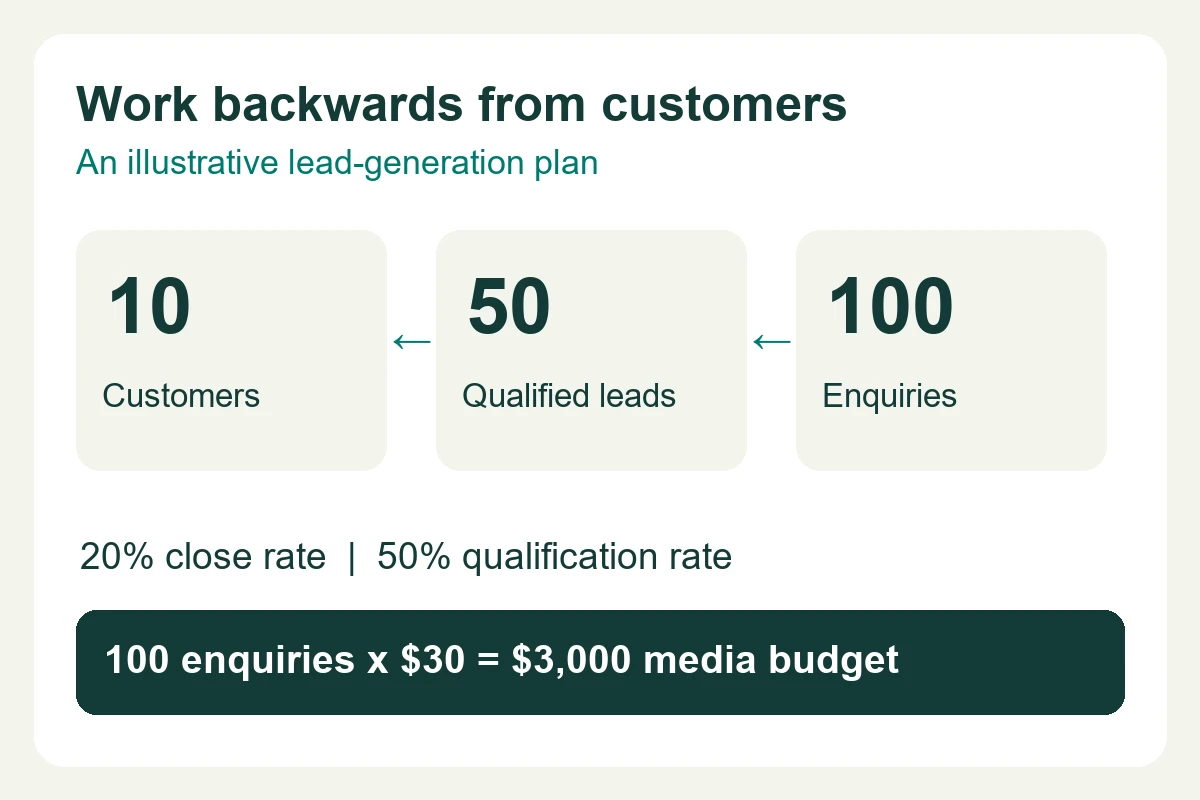
Illustrative example: a service business wants 10 customers. Half of its enquiries qualify, and it closes one in five qualified leads. Its overall enquiry-to-customer rate is 0.50 × 0.20 = 0.10, or 10%.
- Required qualified leads: 10 ÷ 0.20 = 50.
- Required enquiries: 50 ÷ 0.50 = 100.
- At an assumed $30 per enquiry: 100 × $30 = $3,000 in media spend.
- Across a 30-day planning period: $3,000 ÷ 30 = $100 per day on average.
Use one currency consistently. The same arithmetic works in INR, USD, GBP, AED, AUD, SAR, QAR, ZAR, or CAD, but the same numerical cost per lead should not be assumed across those markets. Build a separate forecast for each market using relevant data.
How do you estimate cost per enquiry?
If you have a comparable campaign, divide its media spend by genuine enquiries. Match the campaign objective, destination, geography, and reporting period. Do not mix an instant-form campaign’s lead rate with a website campaign’s click rate.
For a website campaign, another planning relationship is:
For example, $1.50 per landing-page visit and a 5% visit-to-enquiry rate imply $1.50 ÷ 0.05 = $30 per enquiry. Use visits in both parts of this calculation; mixing all ad clicks with website sessions creates a misleading estimate.
Our Facebook ad cost calculator can help you estimate spend, clicks, and impressions from your inputs. Those outputs do not independently predict enquiries, sales, or profit. Add your conversion rates and margins to complete the business forecast.
03Check whether the projected acquisition cost is affordable
A budget can meet a sales target and still lose money. Check how much each new customer contributes after the variable costs of delivering the sale, then decide how much of that contribution you can allocate to acquisition.
Suppose a first purchase brings $1,500 in revenue and $600 in contribution after fulfilment costs. You want to retain $200 toward overhead and profit, and allocate $50 per customer to non-media acquisition costs. That leaves an illustrative media acquisition ceiling of $600 − $200 − $50 = $350 per customer.
Using the earlier 10% enquiry-to-customer rate:
$350 × 0.10 = $35 per enquiry
The base forecast of $30 per enquiry implies a $300 media cost per customer, leaving $50 of room against that ceiling. The ceiling is a limit to test against, not a target Meta is guaranteed to achieve.
Avoid using hoped-for repeat purchases to justify today’s acquisition cost. Use a clearly defined period of observed customer value, account for retention uncertainty, and check whether your cash flow can support the delay before payment.
04Plan an optimistic, base, and conservative scenario
One forecast hides uncertainty. Keep the spend fixed and vary both enquiry cost and sales conversion to see what could happen.
The following scenarios all use $3,000 in media spend. Every assumption is hypothetical; none is an industry average.
| Scenario | Cost per enquiry | Enquiries | Qualify | Close qualified leads | Expected customers |
|---|---|---|---|---|---|
| Optimistic | $20 | 150 | 60% | 25% | 22.5 |
| Base | $30 | 100 | 50% | 20% | 10 |
| Conservative | $40 | 75 | 40% | 15% | 4.5 |
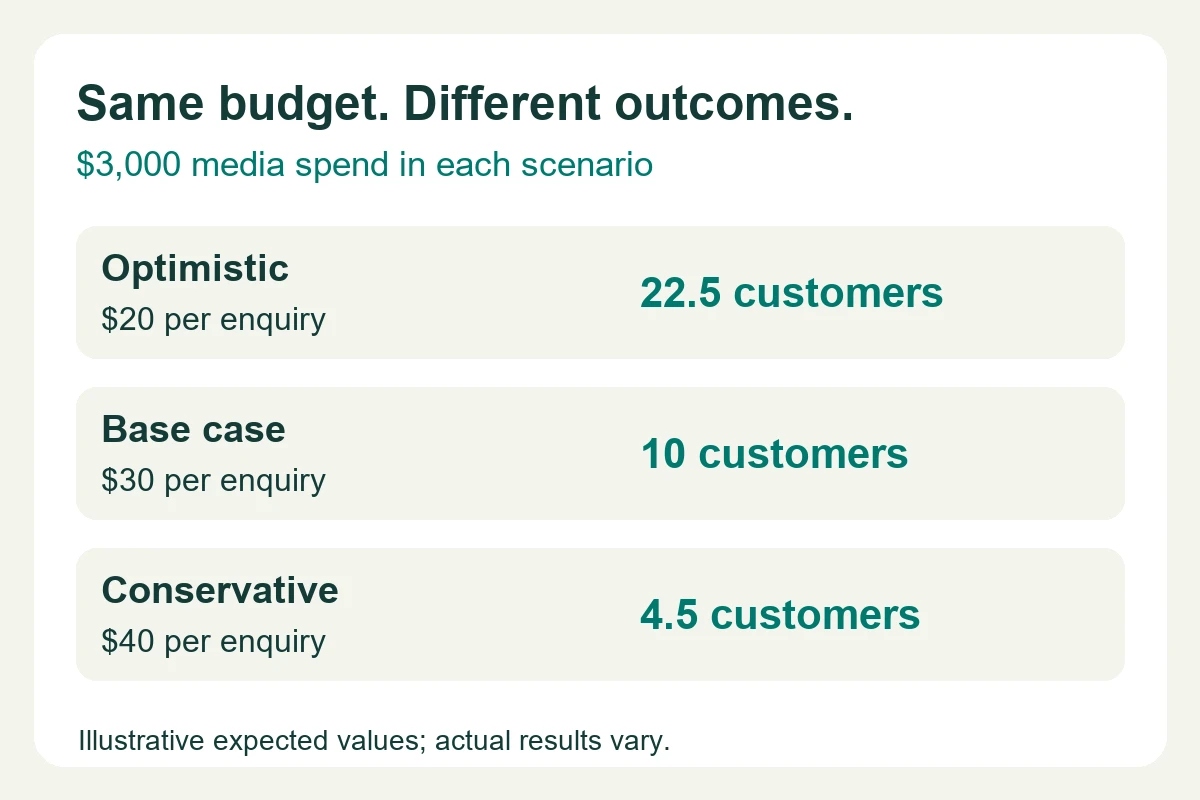
If the conservative case would put the business under pressure, reduce the amount at risk or improve the offer, page, and follow-up process before committing the full budget. If the optimistic case exceeds your fulfilment capacity, plan how you will handle the additional demand.
05Choose settings that fit the plan
Daily and lifetime budgets answer different planning questions. A daily budget expresses average daily spend; a lifetime budget sets spending for the scheduled campaign or ad-set duration. Review the current pacing and spending controls in Ads Manager rather than assuming the daily number is a hard daily cap.
Meta’s campaign-budget course explains budget planning and the auction buying type. Check the options available in your own account before launch, since campaign settings and product interfaces can change.
Keep the distinction between media budget and total marketing cost explicit. Creative production, management, tracking, landing-page improvements, and applicable taxes can sit outside the ad-delivery figure.
A test plan should specify an affordable total spend, the outcome being measured, and a review point. There is no universal amount or duration that guarantees useful results for every industry. A business with a long sales cycle also needs time for leads to mature before judging customer acquisition cost.
06Measure whether the leads can become customers
Track spend, genuine enquiries, qualified leads, customers, and the time needed to close them. A simple spreadsheet is enough to start, provided you apply the same definitions consistently and remove duplicates.
For campaign-level acquisition cost, count the new customers attributed to that campaign under a consistent reporting rule, rather than all new customers across the business. Reconcile platform reporting with your customer records and avoid counting the same customer twice across channels. Attribution assigns credit; it does not, by itself, prove that the ad caused an additional sale. If no customers have converted yet, report acquisition cost as not yet calculable rather than zero.
Media customer acquisition cost = media spend ÷ new customers
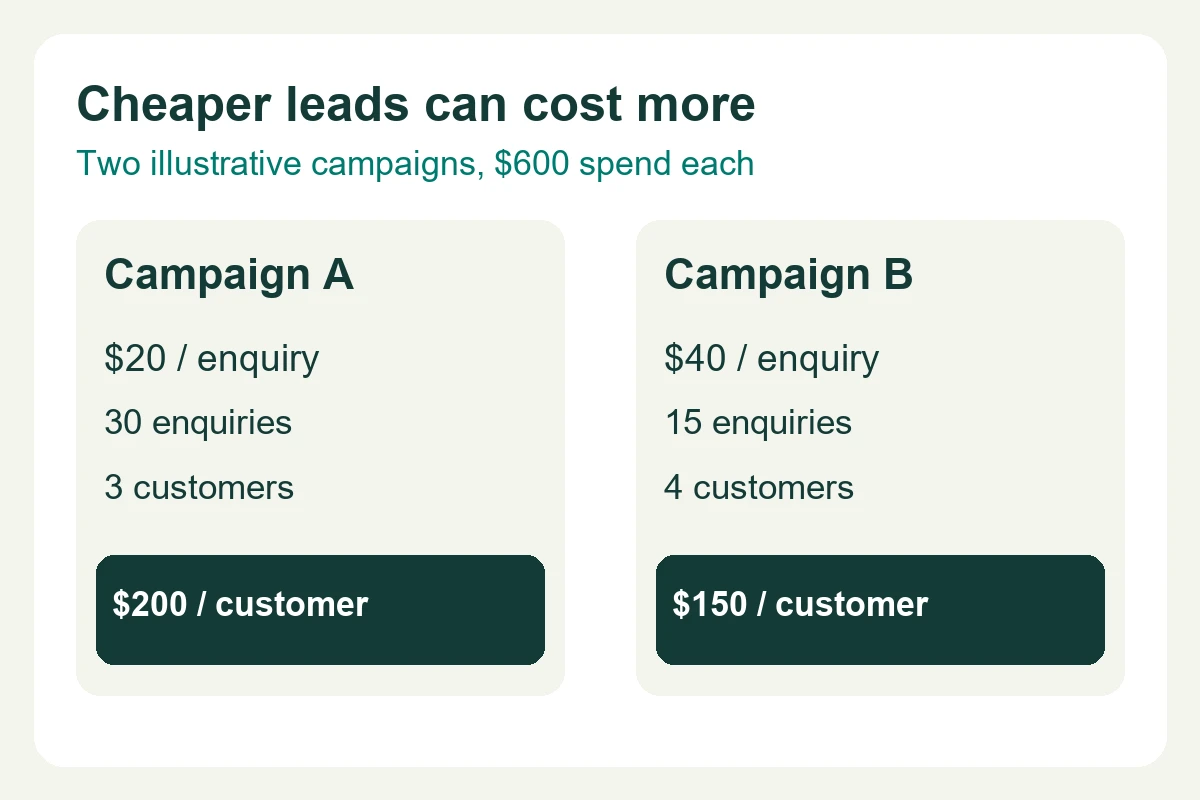
Consider two hypothetical campaigns, each spending $600. Campaign A generates 30 enquiries at $20 each and wins three customers. Campaign B generates 15 enquiries at $40 each and wins four customers. A has the cheaper enquiries, but its media cost per customer is $200, compared with B’s $150.
Where it suits your setup, Meta’s Conversions API for CRM training explains how customer-management data can support optimisation toward lead quality. An integration still needs accurate lead stages and responsible data handling; it does not replace measurement or fix a weak offer.
07Review the budget before increasing it
Check three things together: whether lead quality is acceptable, whether acquisition cost fits your economics, and whether your team can handle more enquiries. If leads are arriving but nobody responds promptly, increasing spend may increase the backlog.
When the model differs from actual results, diagnose the stage that changed:
- Visits cost more: revisit the audience, creative, offer, and delivery conditions.
- Visits do not become enquiries: check the landing page, form, mobile experience, and tracking.
- Enquiries do not qualify: clarify the service, eligibility, location, or pricing expectations.
- Qualified leads do not buy: examine follow-up, proposal quality, objections, and sales-cycle length.
Change one major assumption at a time where practical, record what changed, and allow outcomes to mature. Do not assume acquisition cost will remain constant when you increase spend. If you are comparing channels, our Google Ads strategy guide for small businesses provides a separate starting point for search advertising.
Common questions about Facebook ad budgets
How much should a small business spend on Facebook ads?
Start with an affordable test amount and a forecast based on a measurable business goal. Work backwards from the customers required, the share of enquiries likely to convert, and an estimated cost per enquiry. A fixed daily figure is not suitable for every business.
How do I calculate a daily budget?
Divide the planned media spend by the number of days in the planning period. A $3,000 plan over 30 days averages $100 per day. Actual platform pacing depends on the budget type and settings, so review the controls shown in Ads Manager.
Can a calculator tell me exactly how many leads I will get?
No. It projects outcomes from assumptions. Your actual results depend on delivery conditions, the offer, the enquiry process, lead quality, and follow-up. Use your own results to update the model.
Is a lower cost per lead always better?
No. Compare the qualified-lead rate, customer conversion rate, and acquisition cost. A higher-cost enquiry can be more valuable if it is more likely to become a profitable customer.
Should I use the same budget in every country?
Use the same planning method, but forecast each market separately. Currency, competition, audience response, pricing, and service delivery can differ. A cost observed in India should not automatically become the assumption for the USA or UK.
Put the forecast to work
Write down the customer goal, calculate the enquiries needed, check acquisition economics, and choose a spend you can afford to test. Replace assumptions with measured results as the campaign runs. The useful budget is the one your business can evaluate and sustain.
If you need help connecting campaign planning, tracking, and the enquiry journey, explore Webinnovators’ digital marketing services