

Facebook Ads Leads but No Sales? 7 Checks to Find the Problem
Find where enquiries stop becoming customers, then choose a fix you can measure.
Fix the stage that is failing.Start the diagnosis ↗
Facebook ads leads but no sales can reflect poor lead fit, missed follow-up, unclear expectations, tracking errors, or a sales cycle that has not finished. Compare real enquiries, two-way contact, qualified leads, appointments, and paying customers before changing your campaign. A form submission signals interest; it does not establish buying intent.
01Verify what your campaign calls a lead
Start with one recent group of enquiries from the same campaign and a defined date range. Compare Ads Manager with your form records, messages, and customer relationship management system (CRM). Preserve the original submission date, campaign source, and status as each enquiry progresses.
A lead event is not necessarily a valid enquiry. A click on a WhatsApp button, a page view, a duplicate submission, and a completed form describe different actions. Check what triggers the result you are reporting. Platform attribution and your CRM may also use different reporting rules, so a difference in totals does not automatically prove tracking is broken.
- Submit a test enquiry on a phone and confirm that the team receives it.
- Check that a website lead event represents a successful submission, rather than a form opening.
- Remove obvious spam, test records, and duplicates from your business conversion calculation.
- If browser and server tracking both report an event, have the integration checked for duplicate counting.
- Keep button clicks separate from connected calls and genuine messaging conversations.
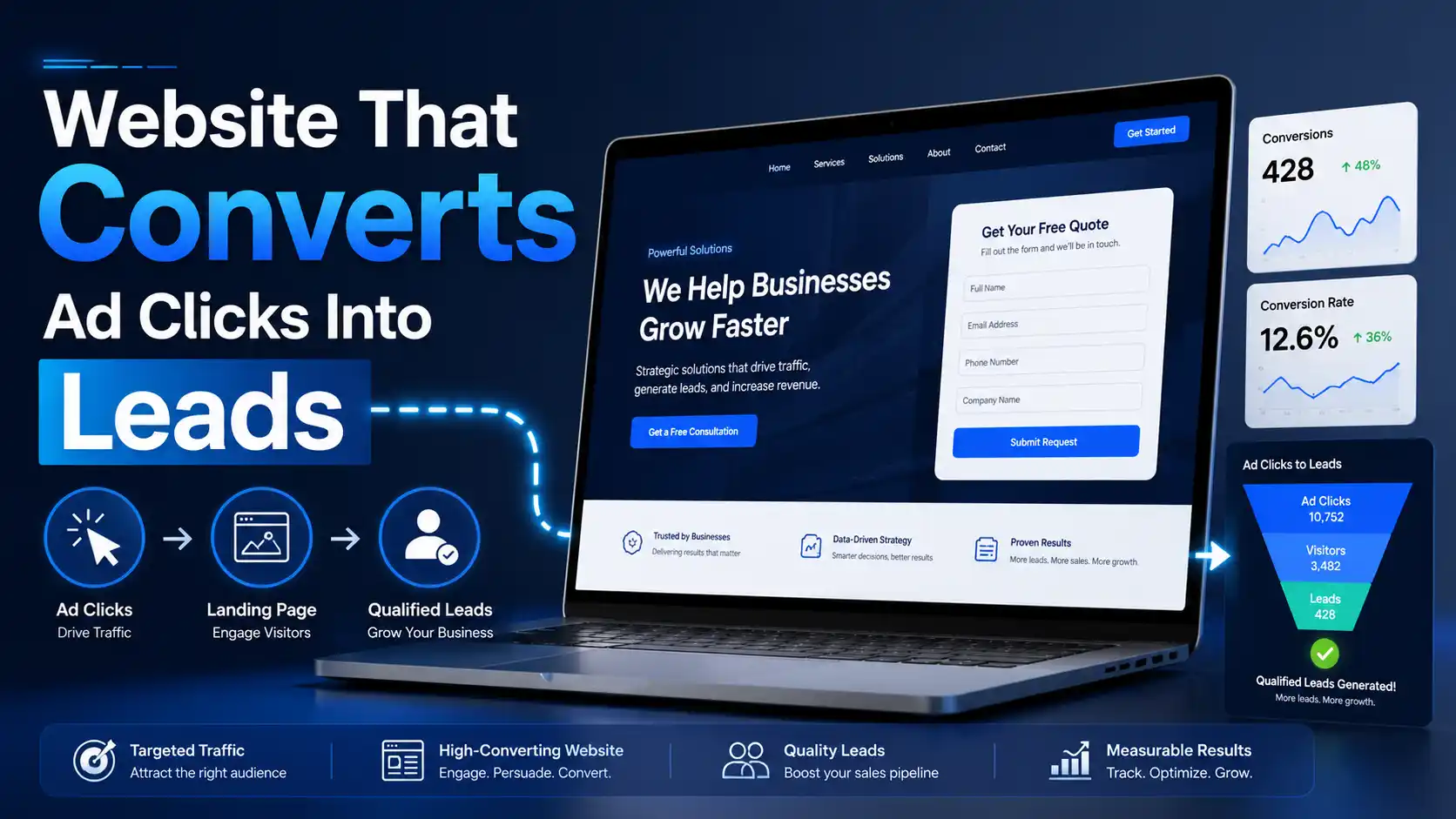
For website campaigns, inspect the next step after the ad as well. Our guide to a website that converts ad clicks into leads covers the enquiry journey before a lead enters your pipeline.
Build a stage-by-stage picture
Imagine 100 genuine enquiries: 40 result in a two-way conversation, 20 of those qualify, eight attend an appointment, and none has purchased yet. These are invented figures for diagnosis, not client results or acceptable-rate benchmarks.
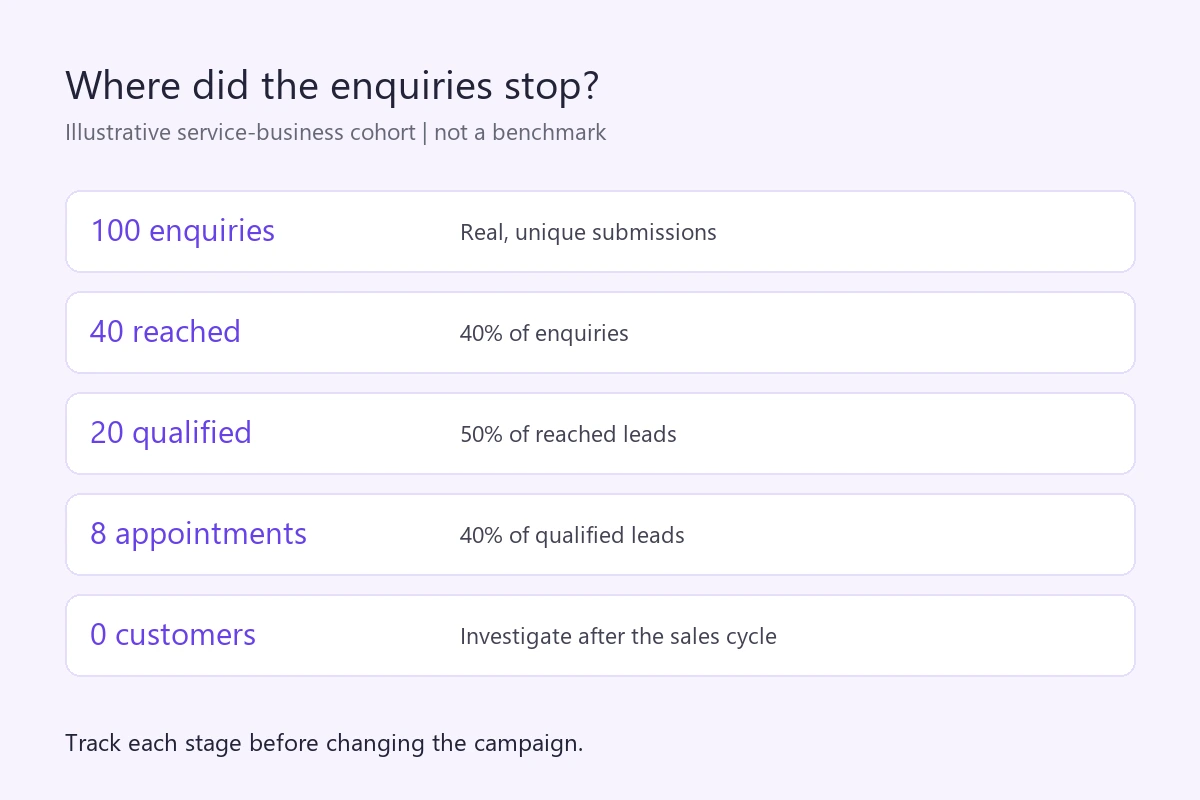
The contact stage deserves attention because 60 enquiries did not reach a conversation. The appointment-to-sale stage also needs investigation, but only after accounting for how long a purchase normally takes. The numbers alone cannot tell you whether the cause is timing, fit, follow-up, or the offer.
02Check whether enquiries reach a real conversation
A sent email or unanswered call is a contact attempt, not a conversation. Record the submission time, first attempt, first two-way response, assigned owner, and next action. This distinguishes leads nobody handled from people who were contacted but chose not to continue.
Test the handoff: does a new enquiry notify the correct person, include the form answers, and arrive during hours somebody can respond? If a campaign runs across countries, account for local time zones and the language promised in the ad. Set a response target your team can meet and compare performance against it.
Your first reply should make the context clear. For example: “Hi [name], you asked about [service] through our Facebook form. You mentioned [requirement]. Would you prefer a brief call or a written outline of the next steps?” Use a channel the person agreed to and respect their communication preferences.
If someone says they never enquired, check the submission and contact details before continuing. Record that outcome separately. Repeated messages to people who object do not improve lead quality.
03Agree on what makes a lead qualified
Marketing and sales need the same definition. For a service business, a qualified enquiry might mean the person needs a service you provide, falls within your delivery area, has a compatible budget range, and has a plausible project timeline. Define criteria relevant to the service rather than assuming a job title or a form completion proves fit.
Choose a small number of questions that change what your team does next:
- Need: “Which service are you looking for?”
- Location: “Where does the project need to be delivered?”
- Timing: “When would you like to start?”
- Scope: “What outcome do you need from the project?”
If price frequently stops conversations, consider an accurate starting range and explain what affects the final quote. Do not use a misleading low price merely to increase submissions. Keep qualification proportionate: unnecessary questions can discourage suitable buyers as well as unsuitable ones.
Record disqualification reasons such as unsupported location, wrong service, or incompatible scope. A single “poor quality” label hides patterns. If most enquiries request something you do not sell, investigate what your creative actually communicates before narrowing audiences.
04Match the ad promise to the paid service
Read the ad, form, confirmation message, and proposal as one journey. A person responding to a free checklist may want the checklist; they have not necessarily requested a consultation or agreed to purchase a service. Keep content downloads and direct service enquiries separate in reporting.
Check whether the ad explains who the service helps, what is included, and what happens after submission. Use genuine examples and evidence you can substantiate. Avoid invented testimonials, client outcomes, and “guaranteed results” claims.
Meta’s training on creative for higher-quality leads discusses creative and instant-form setup as ways to pre-qualify interest. The practical takeaway is to test clearer expectations, then assess the resulting lead fit rather than judging the creative only by click-through rate.
For multi-country campaigns, verify the currency, service availability, language, and appointment arrangements presented to each audience. The same creative can produce different expectations across markets. Review each market’s lead outcomes separately; do not invent a universal country-level conversion benchmark.
05Review the form and enquiry destination
Instant forms, website forms, and messaging serve different journeys. None automatically produces better customers for every business. Choose a destination that gives people enough information and that your team can reliably support.
| Destination | Useful checks | Outcome to compare |
|---|---|---|
| Instant form | Clear service description, relevant questions, confirmation step and delivery to the CRM | Reachable and qualified enquiries |
| Website form | Mobile page clarity, functioning submission, correct event and enquiry notification | Qualified enquiries relative to landing-page visits |
| Messaging | Ad context, staffed response hours, sensible questions and recorded conversation outcomes | Genuine conversations progressing to appointments or customers |
Review the form options available in your Ads Manager account. Labels and eligibility can change. If you test a stronger confirmation or qualification step, measure whether the qualified-lead rate improves enough to justify any change in enquiry volume or cost.
On a website, test the complete flow on a phone: read the offer, fill the form, submit, and check the confirmation. A mobile visitor should not have to guess what they requested or when somebody will respond.
06Follow qualified leads through the sales journey
If people qualify but do not purchase, look beyond the form. Check appointment attendance, discovery conversations, proposal delivery, decision dates, and reasons for lost opportunities. Give every open enquiry an owner and a clear next step.
Different stalled stages suggest different checks. Missed appointments may call for clearer scheduling information. Proposals that are never opened may indicate a delivery problem. Prospects who repeatedly question what is included may need a clearer scope. Lost deals over price may reflect the offer, positioning, or the wrong expectations at the start.
Leave space for an honest “not ready.” Someone researching a project for next quarter differs from a buyer who rejected the offer. Record an agreed next contact date where appropriate rather than treating both as immediate campaign failure.
If eight appointments generated no customers, review those eight outcomes individually. Do not infer that the whole market is unsuitable from a small sample. Check whether the deals remain open and whether the usual sales period has elapsed.
07Measure the business outcome and test one fix
Use media spend and the same lead cohort to calculate the following metrics. State whether qualified leads are a share of all enquiries or only of reached leads; switching denominators makes comparisons unreliable.
Cost per qualified lead = media spend ÷ qualified leads
Media customer acquisition cost = media spend ÷ attributed new customers
When no customers have converted, acquisition cost is not yet calculable; report the spend and zero customers explicitly. It is not zero cost per customer. Attribution assigns credit under a reporting rule, but does not by itself establish that the campaign caused an additional sale.
Here is a second hypothetical comparison. Campaign A spends $600, generates 30 enquiries, qualifies six, and wins two customers. Campaign B spends $600, generates 15 enquiries, qualifies nine, and wins three customers.
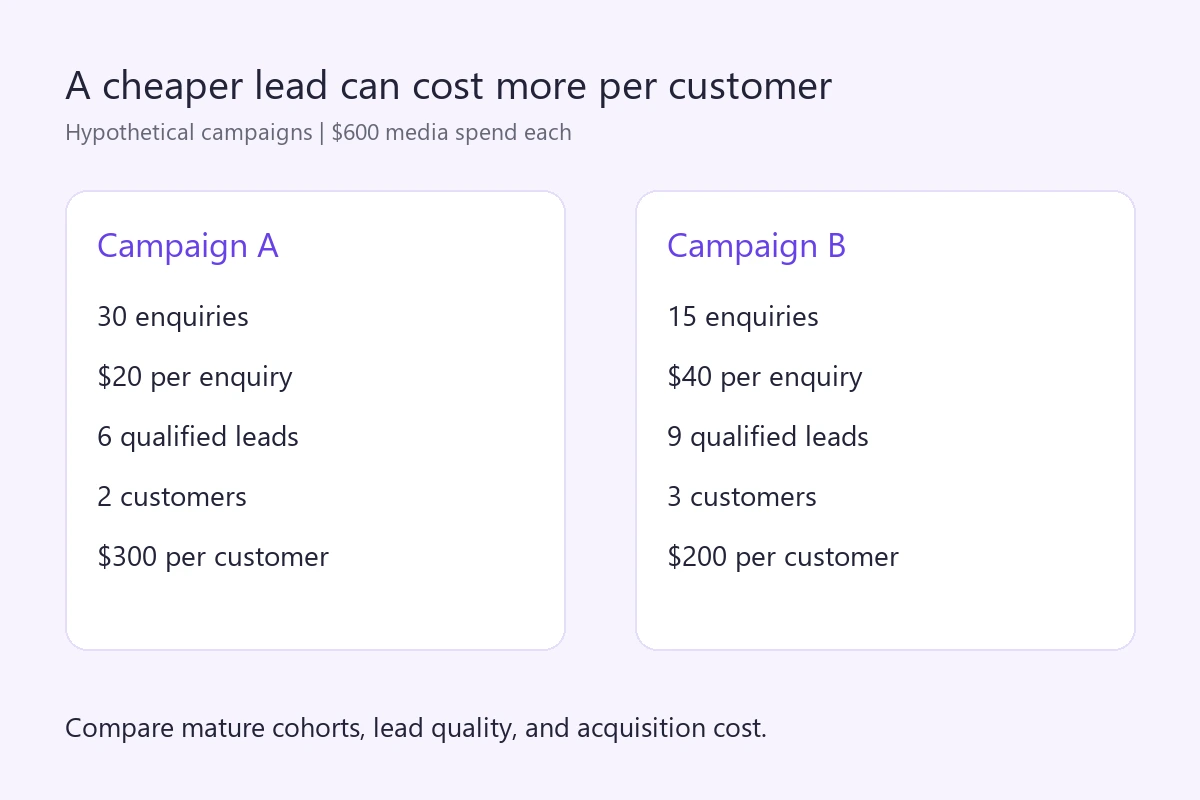
A has the lower enquiry cost, but B has the lower qualified-lead cost: about $66.67 versus $100. B also has the lower media acquisition cost, $200 versus $300. Customer value, fulfilment costs, and the time spent handling enquiries still matter when deciding which campaign is better for the business.
Where your setup supports it, Meta’s Conversions API for CRM training explains using first-party CRM data to support optimisation toward lead quality. Accurate stages and a suitable integration are prerequisites; the connection does not guarantee sales. Confirm current account requirements and applicable data-handling obligations before implementation.
Select a fix based on the evidence: improve enquiry routing, clarify the offer, adjust a question, or repair tracking. Change one major factor at a time where practical, state the outcome you expect to improve, and set a review point that respects your sales cycle. A simultaneous redesign of every stage makes it harder to know what worked.
Before increasing spend, check customer economics using our guide to calculating a Facebook ad budget. Our Facebook ad cost calculator estimates spend, clicks, and impressions; it does not independently predict lead quality or sales.
A practical audit for your next review
- Trace one enquiry: confirm submission, event, notification, owner, first reply, and recorded outcome.
- Review a comparable cohort: group recent leads by contact, qualification, appointment, open opportunity, and customer status.
- Read unsuccessful outcomes: look for recurring reasons rather than a generic “bad leads” label.
- Choose a single test: record the change, campaign, date, owner, and metric used to judge it.
- Check affordability: include sales effort and non-media costs alongside acquisition cost.
Common questions
Why am I getting Facebook ads leads but no sales?
Possible causes include unsuitable enquiries, unsuccessful contact, unclear expectations, a weak sales handoff, incorrect reporting, or leads that need more time. Follow the same lead cohort through each stage to find evidence for the cause.
Should I stop the campaign immediately?
Pause or limit spending when enquiries are not being delivered, the offer is misleading, or the test exceeds what you can afford. If qualified opportunities remain open, review their age and progress before concluding that the campaign failed. There is no universal stopping rule.
Will adding more questions improve lead quality?
Relevant questions can help identify fit, but added friction can also reduce suitable enquiries. Test questions that affect qualification or routing, then compare qualified-lead cost and later outcomes.
Should I switch from instant forms to a website?
Consider a test if people need more explanation before enquiring or your current flow creates unclear expectations. Compare the complete journey, including mobile usability, contact success, qualification, and sales; switching destinations alone does not guarantee improvement.
How long should I wait for sales?
Use your own sales-cycle records. Allow a cohort enough time to reach a realistic decision, while checking earlier stages as it progresses. Newly submitted leads and mature opportunities should not be judged on the same timetable.
Turn the next enquiry into useful evidence
The next step is a reliable record of what happens after somebody submits. When you can see which stage stalls, you can choose a focused test and evaluate its effect on customers and acquisition cost.
If you need help connecting campaign tracking, lead routing, and the enquiry journey, explore Webinnovators’ digital marketing services.